Hip Hop 2009: The Big Picture
Posted by Justin Boland on Aug 25, 2009 | 17 comments
For the past 10 years, everything about the music business has been changing completely, every 3 months or so. There has been a lot of confusion, mythology and empty hype. I’d like to pause and take in the Big Picture, though. I’ve been digging through piles of reports, several notebooks worth of notes, and focusing on one simple question: what do we really KNOW about the music business in 2009?
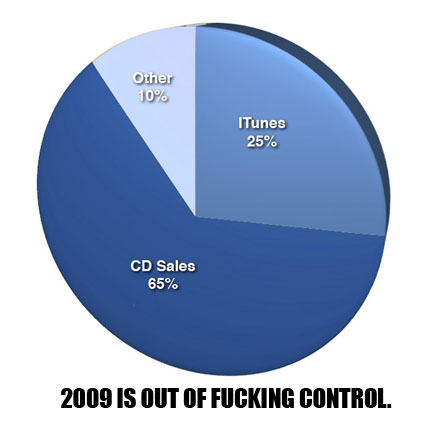
You’ve probably heard of this guy named Steve Jobs. He represents a unique corporation, one that’s managed to brutally fuck up several consecutive industries in the space of 20 crazy years. One of those industries is music, because Steve Jobs currently makes up 1/4th of the entire music business in 2009, if these NPD Group numbers are accurate.
Apple eating right off Bronfman‘s plate is big news, for sure, but I was just as surprised to see that compact disc sales still makes up 65% of the whole biz.
Overall, though, when I look at these statistics laid out on this pie chart, I have to question the methods behind the numbers. It just reeks of bullshit—the music business is way more diverse than CD sales and mp3 downloads. If the market for acoustic guitars is valued at $472 million dollars and Rock Band video games are already worth over a billion, there’s a lot more money floating around in the ecosystem than just record labels, publishers and distribution. And what about live gigs, from corner bars to city stadiums?
We’re about to explore all this and more. But first, I know what you’re thinking…people are still buying CDs?
Who is moving CD units in 2009?
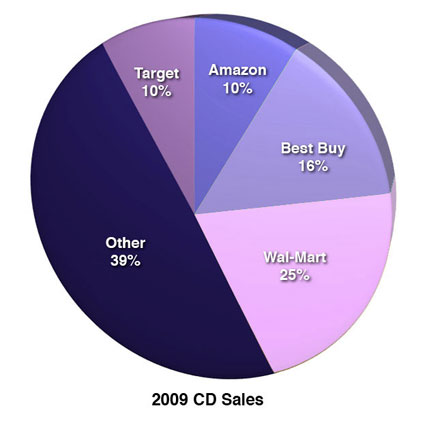
For a “dead format,” the compact disk is still a thriving product. The market is dominated by box stores, with Wal Mart and Best Buy making up over a third of the entire market. It’s unclear how much Wal Mart’s online sales contribute—for instance, does Wal Mart’s website sell more CDs than Amazon? I’d like to know, but that remains to be seen.
Here’s the big picture for 2008: although Billboard says that total album sales are 430 million, only 362 million of those were actual CD copies. That same year, 33.4 million of those units were from a category known as “Rap Albums”—and that’s the only category we care about here at Audible Hype.
I would love to see a genre breakdown for this chart, but I can’t find that data anywhere. (I’m willing to bet that Best Buy moves more hip hop than Target does, for instance…but what about Amazon?) I would also appreciate access to an international breakdown of album sales by genre (does Switzerland love the Wu more than Germany?) but it’s been about a week of research and I’ve given up hope. There’s a lot of dead ends when I start getting too specific, so let’s move on to the next Big Question…
Who is selling digital albums in 2009?
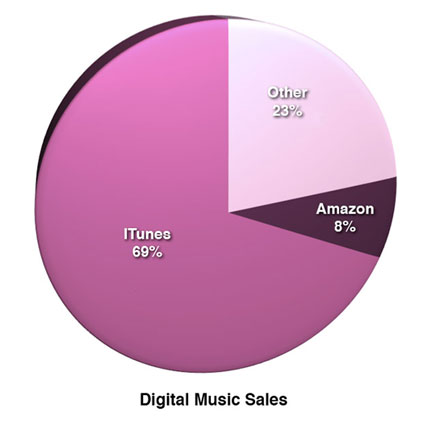
Sure enough, Apple owns this category, with no mercy. Their second place competitor is Amazon, with a mere 8% of the market share. Ouch.
This kind of King Kongzilla dominance makes more sense when you consider the sheer scale of iTunes. They’ve moved 8 billion songs already, and they’re projecting that they’ll break 10 billion by the end of 2009.
The beauty of the internets: you can sell product 24 hours a day and your customers can be pretty much anywhere in the world. Here’s a good indication of the international market, though—it’s definitely a “Long Tail” situation because just 5 countries make up 95% of the entire market.
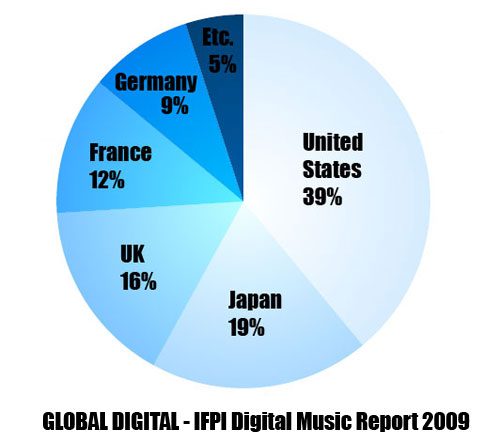
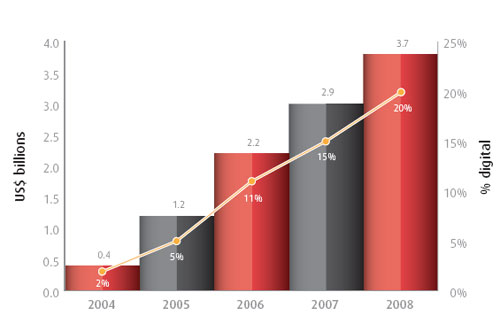
That 5% that’s left? That’s the future of hip hop right there. More than anything, this data tells me that the international market for digital hip hop is about to explode. Digital market growth has been sharp in every country where it takes root. That’s definitely been true in the United States these past five years:
…And What About Live Music?
Unless the Federal Government intervenes, the live music industry will look just like everything else we have explored so far…completely dominated by a single corporation. At the moment, it’s technically two corporations: TicketMaster and Live Nation.
Live Nation has been making big moves. In 2009, they’ve got over 22,000 events scheduled. That’s not all concerts, though: Live Nation has it’s paws in mixed martial arts, monster truck events and even tennis tournaments. (Basically, if you can charge $10 for a bottle of water, Live Nation is there.) It’s worth noting that Live Nation is “making big moves” because they were never small time: they split off from media giant Clear Channel in 2005. Despite seeing some downturn in revenue during summer 2009, Live Nation still sees more revenue than Sony Music or EMI does.
They’re also working on being a record label, taking the interesting approach of signing major league artists like U2, Jay-Z and Madonna, and then outsourcing the meaningless little details like “marketing, promotion and distribution of albums.” The funniest part is that they’re generally outsourcing right back to the same labels the artists used to be signed to, especially Warner Music Group.
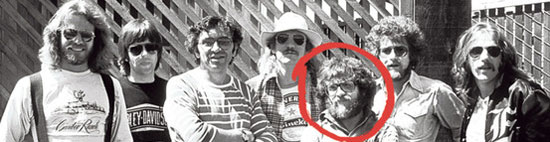
Ticketmaster was never small, either. In 2008, they claimed $1.4 billion in revenue and $1.7 billion in assets (which is actually down from 2007, when they claimed $2.3 billion in assets). They’ve also got the dubious distinction of having a genuine Evil Dwarf for a CEO: the legendary cut-throat Eagles manager Irving Azoff. He also represents smaller, more obscure acts like Guns and Roses, Aerosmith, Van Halen and Christina Aguiliera. In 2008, his company Front Line Management was bought by Ticketmaster under unusual conditions: Azoff would head the entire corporation and the former Ticketmaster CEO, Sean Moriarty, would report to him.
Educated Guesses

Yeah, I wish I could leave you with a more detailed, less depressing Big Picture. Data is power in 2009. The music business leverages disinformation and secrecy, and they’ve got no interest in making accurate numbers available…especially to artists.
Think about it: what states have the highest sales of hip hop albums per capita? That’s a valuable question, and there’s no doubt that Sony, Warner Music, Def Jam and dozens of other major companies have answers. Not The Answer, of course, since they’ve only got their own data. It’s funny: if they would make their data public, we could combine them and everyone would benefit. Instead, we live in a culture where’s it’s considered more sensible to hoard that incomplete data and keep everyone else in the dark, too.
However, in the next installment of Hip Hop 2009, I’m going to be working out that exact question—where are the biggest markets for hip hop?—by examining indicators like tour schedules, radio formats, promo appearances, and successful artists.
As always, if you know anyone else working on similar projects…let me know. I doubt I’m the only person trying to figure all this out.
Open Questions
1. Is Myspace dead yet? It’s broken, it’s ugly, but according to Forrester Research there’s still 139 million users every day.
2. How many units of “Rap Albums” moved in 2002 and 2003? I’ve never been able to find that data and I’d like to fill that fucking gap so I can graph it.
3. Most importantly…what other questions should I be asking? What’s missing from this version of the Big Picture? What answers do you want me to be digging for in future articles?

17 Comments
1 Vertical Paul says...
LMAO @ that first pie chart!
If you bought a billboard membership could you get that state by state info?
Posted at 9:13 a.m. on August 25, 2009
2 Wesley Verhoeve says...
I'd like to know why the rest of the world, including MANY huge industrial countries, aren't selling downloads like the top 5 is.
Posted at 9:28 a.m. on August 25, 2009
3 Mario Mendoza says...
Great work Justin. I've been trying to find alot of these figures, and you are right, if more data was exposed it would make our lives easier as indie musicians, at the very least helping plan out better strategies without such a blind approach. I believe in the new music models but at times, its discouraging not finding the relevant data to back up these new marketing strategies.
That IFPI digital report is sick, 5% never sounded so good. These newer outlets could be the savior which fuels a lot of these indie operations, I know it fuels mine. It's all about niche placement and getting in on the ground floor of expanding markets.
My biggest concern is matching up our genre into its right digital distribution outlet, especially in the international area.
I will definitely keep posted on this HIP HOP 2009 series. I will shoot you any extra information I can find through research. Digging in the Crates is not just for DJ's.
Posted at 1:55 p.m. on August 25, 2009
4 Chet says...
Sales by state? That's all Soundscan data, accessible to those who have an account (not just labels).
MySpace has been experiencing "white flight" to the superior user experience of Facebook. Among minorities, foreign countries, and the very young, use has been growing... not a bad demographic for hip hop.
Posted at 2:45 p.m. on August 25, 2009
5 Quiet Entertainer says...
139 million users on myspace daily; but how many of those are bands, bots, interns, labels, and projects? I have wondered.
Posted at 4:57 p.m. on August 25, 2009
6 Justin Boland says...
@ Quiet Entertainer
Well, you're in luck, I actually tucked some interesting information aside. This is courtesy of the Forrester Research group, and it's their census of Myspace Music pages:
Hip Hop 2.5 million
Rap 2.4 million
Rock 1.8 million
R&B; 1.6 million
Pop 723,000
Metal 611,000
Punk 468,000
Electronica 413,000
Techno 335,000
Reggae 314,000
It's amazing how far hip hop is in the lead-as far as I'm concerned there's a philosophical difference between people who self-identify as "hip hop" or "rap," but business-wise that's the same gene pool..and damn, that's 4.9 million artists!
Throw in R&B;and the "Urban Consumer" demographic is pretty much the reason myspace exists in 2009.
Posted at 8:30 p.m. on August 25, 2009
7 Theresa says...
Great read.
Posted at 3:28 a.m. on August 26, 2009
8 Shomi says...
Great info Justin! I came across your blog when I read one of your comments on one of the many music business blogs I read every week. Now I just mainly read yours!
Posted at 3:32 a.m. on August 26, 2009
9 David Salinger says...
I think that the Live Nation / Ticketmaster is a foregone conclusion. It's good for investors and investors are primarily major Wall Street players. I realize this is beyond the purview of a music promotion blog, but the Obama administration has proven itself to be very much "bought and sold" when it comes to watching out for the interests of Wall Street.
Several of my colleagues disagree vehemently, though, and I should also mention their opinions, which basically boils down to three points. First, that the realm of live music is of very tangential and minor interest to Wall Street players...I believe I've seen you mention, Justin, that the real money is definitely not in the music business, it's in higher volume, higher leverage markets.
Second, that Irving Azoff, or the "Evil Dwarf" as you called him (still laughing about that) has perhaps burned too many bridges and there's a number of equally powerful forces who want to block him out of both professional concerns and personal spite. Having spoken to the man, I can assure you his chainsaw tantrum days are long gone, he is very urbane and downright wise, but his reputation within the industry hardly reflects that.
And Third, well, I forget and I've typed too much laready. Back to work.
Posted at 9:31 a.m. on August 26, 2009
10 Manuel says...
On my side of the world (Europe) myspace.com can be considered as dead. Sure, we still get hits and request from other musicians but there's rarely any interactions from fans anymore.
Our small label has released an album in early 2009 and it drove lot's of traffic to the artist's profile. Another release of the same quality in july didn't give us a fraction of the hits.
My clues:
Facebook has taken over!
Fans want REAL interaction, not just digital news!!!
Posted at 10:58 a.m. on August 26, 2009
11 MalaKai says...
In general, great article. Don't forget to factor in merchandise alonside record sales, ticket sales, and radio play, etc. I wouldn't be suprised if t-shirts and posters made up at least a third of a lot of artists' revenue. There's also the unmentioned export distribution dollar for physical CDs, especially for niche markets. I have a friend who works with a Scandinavian distributor specializing in death metal, and from what I hear they ship tons of CDs from the States overseas. I should expect no different from hip-hop, where it seems that demographics might be expanding as popularity for the genre increases in previously untapped areas. If you think about it, underground/regional hip-hop in America from 1994-2001 was in some ways boosted by a sort of cultural tourism. Kids from California suburbs took great pride in digging out obscure artists all the way across the country in somewhere like New York. I see much of the same type of phenomena at work on the international level.
1) I can't really answer this. From my perspective, I'm not a fan of Facebook only because I tried it, twice, and honestly didn't like it. It seems like a more closed-off network than Myspace, and way more constricting. You're more encouraged to sign up than you are to find your favorite bands on it. I think all social networks are preferences most people don't make for themselves, simply because they don't want to get left behind when all their friends move from one to another.
2) No clue on this one.
3) Maybe find some independent stats. For example, where does that 39% "other" in 2009 CD units actually come from? What about the 23% "other" in digital? I'd like to see how many artists are actually doing it themselves completely versus going through a third party service, and what the benefits and drawbacks would be from this approach.
Posted at 7:01 p.m. on August 26, 2009
12 Gigdoggy says...
Very nice read Justin.
As for those questions:
1)don't think Myspace is dead just yet - the company itself is still very active and artists are still signing-up everyday. It's probably only dead for the muso-geeks who are well aware of all the other tools out there to promote their music.
2)No idea
3)I would like to know how gig revenue in the hip hop realm plays out vs gig revenue for indie/rock bands.
Posted at 6:09 a.m. on August 27, 2009
13 Fresh Daily says...
dude, this blog is awesome.
thank you.
Posted at 10:36 a.m. on August 28, 2009
14 Martha Cohen says...
We're coaching our urban artists to aim for ubiquity before monetizing anything. The more of your content you can get into the digital stream, the greater the percieved value of your brand. This is something artists are resistant to! I'm sure you've been there...they want to make point of purchase money. What we're telling them is that point of purchase is pretty obviously gone. Numbers do not lie, despite the fact people routinely use numbers to lie.
The money is in corporations-sponsorship, sync money, co-branding. I am surprised you haven't written about the Blue Scholars yet, I would like to see your take. You need to first prove you've got a lot of eyeballs, then you leverage that to get money from the people who actually have it, our corporate overlords, ha ha.
My biggest piece of advice: get a communication channel you control so you can talk to your fans...listen to them, ask them what they want...then deliver that as quickly as possible! Then, repeat that process as often as possible! You're sprinting in 2009.
Thanks for the good read! Had to give my $0.02
Posted at 10:25 a.m. on September 10, 2009
15 Jahson The Scientist says...
Many thanks Justin,
You connected many dots in your picture.
Definately wouldd like to see more dot to dots on the OTHER for CD & Digital sales.
For me, I still like the idea of owning a physical product especially when the artwork is great and the artists have some depth of character. As an artist I want to give my fans just that.
Oh and about the other 5%, thanks for highlighting it.
Martha's & Others comments were also very useful.
As I start looking more at figures in this business, this certainly has been the most helpful blog thus far to enlightening this neophyte.
Jahson
Posted at 11:52 a.m. on September 18, 2009
16 Frank says...
Yeah, I'm one of those people. I have learned that purchasing music online is a bad move. Hard drive crash or some crazy mishap and the music is gone. A tangible disk will always ensure that the music is easily replaceable without having to kiss someone's ass at Apple.
There have been great strides as of late to rid media of DRM. However, Until it is completely gone there will be those of us who will refuse to buy into a huge money pit.
The recording labels are not the only way to spread your music around. Creative Commons artists are having great successes. This does put all of the publicity on the artist so it is up to them to get things going. I've discovered many great artists on places like Jamendo and Magnatune that I would have otherwise disregarded had I stuck to record labels.
If you love art for the sake of art then creative commons is for you. If you think you are good enough to get a record label then go for it. But there are loads of delusional artists out there.
Posted at 7:46 p.m. on September 25, 2009
17 Boundless says...
WOW. Thank you for this one. The music industry needs MORE people like you and LESS people like Diddy.
Posted at 5:27 a.m. on October 1, 2009